From his office in Odesa on the northern coast of the Black Sea, Vitalii Schmulevych expands on the tour he would like to give a visitor to this city of his birth. “You would see the beautiful 19th-century opera house; we could go to the fish market and choose fish that has been pulled this night from the sea, so fresh it has never been refrigerated. If we eat fish, I would propose a glass of sauvignon blanc or pinot grigio.”
A leisure trip to Ukraine being very obviously in the realms of fantasy, the chief executive of the country’s largest wine producer, Bolgrad, is speaking to me over Zoom.
Sales of Ukrainian wine in the UK have increased in the four years since Russia launched its invasion. The small, family-owned Beykush winery, to the east of Odesa, is one of some 10 producers imported by the Ukrainian Wine Company – which sold 37,000 bottles in the UK last year, up 20 per cent from 2024. Meanwhile, in London, and beyond, a growing cohort of restaurants, such as Sino, which opened in Notting Hill last spring, celebrate Ukrainian cuisine while introducing diners to sukholimansky bely (a cross of chardonnay and the Moldovan grape plavaï).
Has the unwelcome spotlight created by the war also brought people to the country’s wine? “Tough question,” says Schmulevych, a notably composed and reassuring presence on the screen. “Before 2022 we were exporting our wines to Japan, Israel, Africa and Europe. For sure [interest] was increased, mainly because of questions like, ‘How can you still work? How can you still produce? How can you still earn gold medals in the international competitions? How can you still do what you are doing?’”
Part of the answer to those questions is a steadfast refusal to be subdued. In Odesa, the missiles come every night. “If we hear that it’s very, very loud, for sure we go to the shelter. If it is not so loud, we stay in bed. Thanks to our army that is protecting us. We are just living and we try not to think about it. Because we need to show that nothing will change this position.”
Wine is a means of expressing place and identity, and sharing joy and companionship: a “positive emotion” Schmulevych says Ukrainians “would like to transfer and share with the rest of the world”.
The country’s vineyards span many regions and climates, hosting a mix of largely international grape varieties with local grapes becoming increasingly popular, in line with the global trend of celebrating regional difference.
Zakarpattia in the far west, abutting the borders of Slovakia and Hungary and protected to the north by the Carpathian mountains, is a place where many white grapes thrive: traminer, muscat ottonel, furmint and riesling. Bolgrad (the company is named after the town of the same name) is based in the Black Sea region, where it grows sauvignon blanc, chardonnay and pinot grigio, among other white grapes; also pinot noir, cabernet franc, cabernet sauvignon, saperavi and Odesa black, an alicante bouschet and cabernet-sauvignon cross.
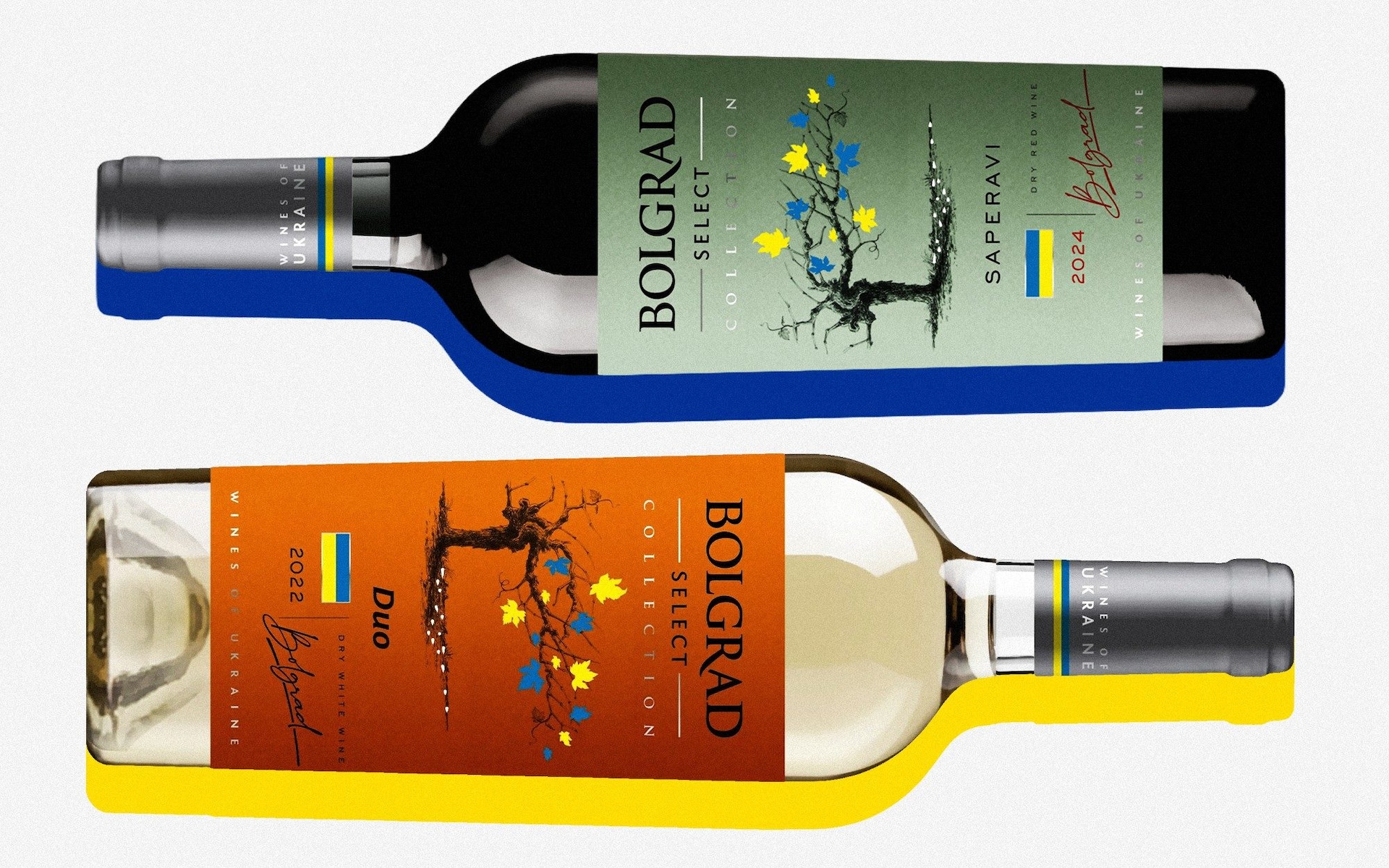
It’s here, close to the Romanian border and the shores of the freshwater Lake Yalpuh, that Bolgrad grows the grapes for a pair of wines, a pinot grigio and an especially good saperavi – a characterful but approachable red, like elderberries with a jab of acidity – on sale this month in Lidl at £8.49 apiece.
£8.49 at Lidl
Distance from the frontline does not confer safety: vineyards are, out of necessity, equipped with shelters to protect workers from persistent attacks from drones coming in through Moldovan airspace. Schmulevych says that winemaking in this southerly region is heavily influenced by settlers, some three or four hundred years ago, from Germany, France and Switzerland, and calls it the “heartland” of Ukrainian wine.
This latter point is controversial: many Ukrainians still regard the balmy peninsula of Crimea – “temporarily occupied by the Russian federation since 2014”, as the Wines of Ukraine website has it – as the jewel in Ukraine’s vinous crown. Crimea is not just the location of many hectares of vineyards, it also has a very distinctive niche in wine history: it is the home of Massandra, near Yalta, a winery founded by Nicholas II to supply his imperial summer palace, and famous for its strong, sweet wines.
The size of Ukraine’s national vineyard has risen and fallen and risen many times since those days, ravaged first by phylloxera (an aphid-like insect which devastated European vineyards in the mid-19th century), then two World Wars and the Soviet anti-alcohol campaign of the late 1980s. As well as bringing some vineyards under occupation and others under hostile fire, the current invasion has also created a series of problems that Schmulevych files under the heading “logistical challenges”.
These include the destruction of the Gostomel factory in Kyiv (now, apparently, repaired) that caused a glass bottle shortage across Europe; the constant need to find new export routes out of the country; the recent power outages caused by Russian strikes on energy facilities in temperatures of –12C; and persistent attacks on Odesa infrastructure, including bridges, to all of which Schmulevych, without so much as a flicker of a lustrous eyebrow, says calmly, “If you want to solve the problem, you will solve it.”
There is one more message he would like to get across and it is this: “We are more than appreciative of all the people who support us, but mostly Ukrainians don’t want that their goods should be bought because of compassion, because of…” Pity?
“Yes. We want it to be chosen because of quality and tradition and because it is competitively priced.”
I have one more question, no, make that two. First, can he describe the taste of the Odesa black grape? “Uh, wow, imagine that you’re tasting a very soft jam, you’re taking cherry, you’re taking plum, and it’s powerful, smooth and light at the same time, we are trying to make very light and drinkable wines.”
And, last question, if I were in Odesa, what would you recommend to eat with the Bolgrad Saperavi in Lidl? “Lamb, marinated with salt and any herbs or spices and grilled, barbecue-style.” That sounds good to me.