
Trending:
Scientists are sending AI to the moon - and it will make its own decisions
Artificial intelligence is about to take its first steps on the Moon. The UAE’s Rasheed rover carries a machine learning system designed to identify minerals and geological formations without constant instructions from Earth. Because signals between Earth and the Moon take about 2.7 seconds to travel, giving robots the ability to make decisions on their own could dramatically change future missions. The rover will operate for roughly one lunar day, gathering data and training its algorithm as it explores the surface. This experiment could shape how future robots explore the Moon, Mars and beyond.
Scientists are on the cusp of releasing the first universal vaccine
Microbial threats against human health are only growing. Luckily, researchers are developing new vaccines that are up to the challenge.
Scientists discover how 'super agers' stay mentally sharp
A new study found that some people in their 80s and 90s think like they’re decades younger — and their brains make new cells at twice the normal rate.
Researchers test Mars soil on one of Earth’s toughest creatures, the reaction was unexpected
Mars may already possess a built-in defense against contamination from Earth. Experiments using simulated Martian soil show that some compounds in the regolith can damage or inhibit microscopic organisms. Researchers investigating the habitability of Martian soil recently observed that certain regolith compositions can strongly affect living organi...
Why the world's biggest aquarium broke
In the heart of Berlin, engineers built the world’s largest freestanding aquarium and placed it inside a luxury hotel. For years it was celebrated as a marvel—until one night, a million liters of water tore through the building in seconds. Investigators searched for sabotage, defects, and bad luck, but the deeper story points to overconfidence and ignored risks. This is what happens when spectacle comes before fundamentals.
A rocket launch costs $28 million – and that’s the cheap part
Launching a rocket into space is far more complex than most people imagine. Behind every launch is a massive industrial operation involving thousands of parts, hundreds of engineers, and weeks of preparation. A single Falcon 9 rocket contains engines worth millions of dollars, hundreds of tons of fuel, and hardware transported across the United States before it ever reaches the launch pad. Even with reusable rockets, a typical launch still costs tens of millions of dollars. The scale of engineering and logistics required to reach orbit reveals why spaceflight remains one of the most difficult achievements in human technology.
Scientists detect the most powerful space laser ever seen, 8 billion light-years away
MeerKAT telescope discovers most powerful space laser ever found, detecting a hydroxyl gigamaser 8 billion light-years away using gravitational lensing.
20 science facts that sound fake but are 100% true
Discover 20 science facts that sound completely fake but are 100% true. These surprising facts will change how you see the world.
The nuclear test that scientists feared might ignite Earth’s atmosphere
J. Robert Oppenheimer led the scientific effort that created the world’s first atomic bomb during World War II. The Trinity test in 1945 produced an explosion equal to nearly 25,000 tons of TNT, marking the beginning of the nuclear age. Some scientists had even feared the blast might ignite the atmosphere and destroy life on Earth. The weapons developed under Oppenheimer’s leadership were later used in Hiroshima and Nagasaki, killing more than 225,000 people and permanently changing global warfare.
Who was the world’s first scientist?
Who was the first scientist? This episode dives into ancient thinkers, Islamic scholars, and the evolution of science before the scientific method — uncovering how observation, curiosity, and early peer review shaped what we now call science.
What the science actually says about the planet’s next 50 years
What will the next 50 years look like for Earth? Explore what current scientific research says about climate change, technology, ecosystems, and the planet’s future.
Voyager 1 approaches a historic milestone as signals from Earth soon take an entire day to reach humanity’s most distant probe
Voyager 1, launched in 1977, remains the most distant spacecraft ever built by humanity. Now traveling through interstellar space beyond the heliopause, the probe continues sending back valuable data about the environment between stars. Soon, radio signals from Earth will take a full day to reach the spacecraft, marking a historic milestone that highlights just how far this tiny explorer has traveled.
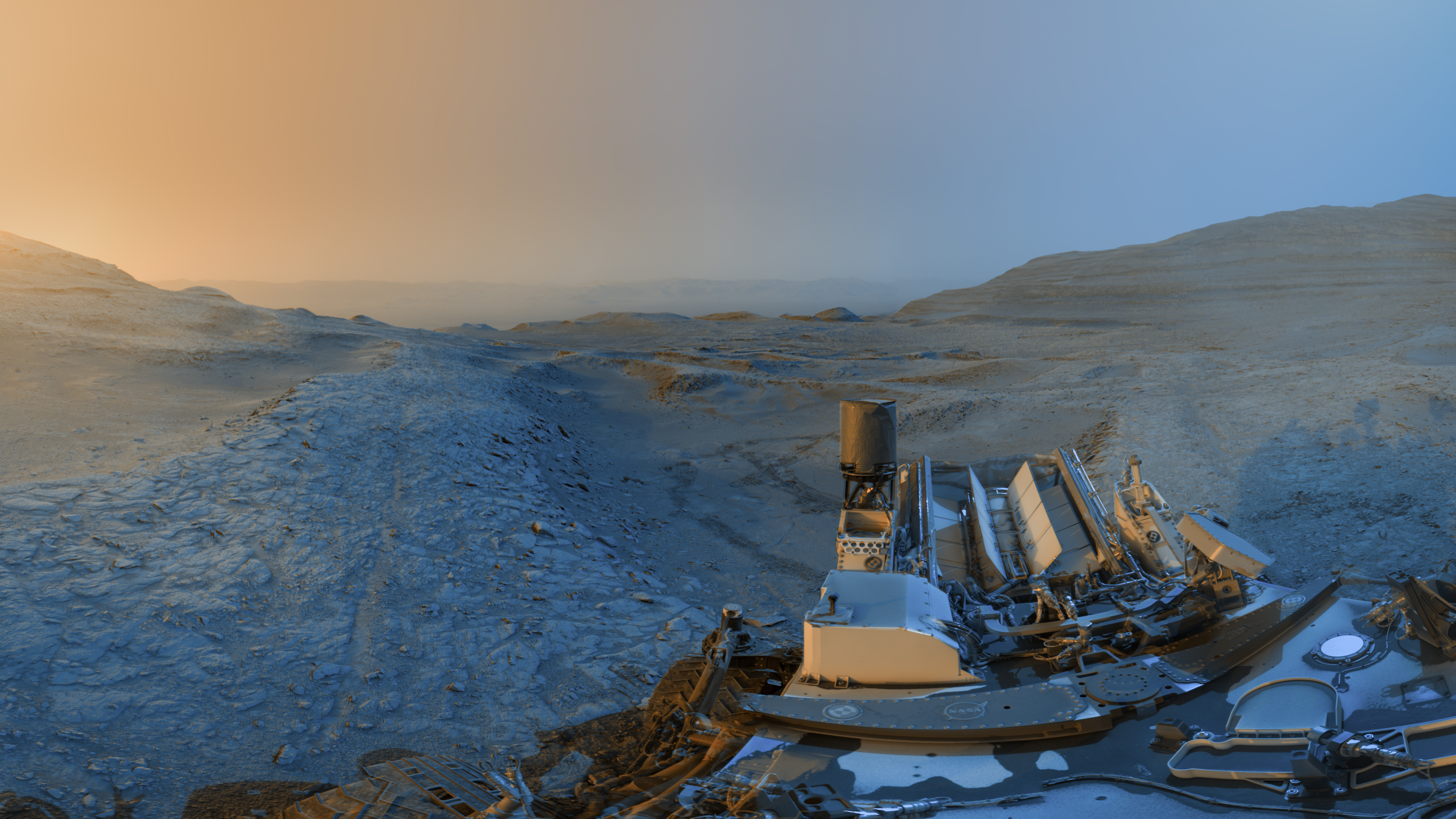
Mysterious never-before-seen egg-like structures found on Mars
Nasa’s Curiosity rover has been investigating the spider-web-like rock formations found on Mars – and found mysterious egg-like structures. Newly issued images show giant zig-zagging ridges, known as ‘boxwork’, spread across the slopes of Mount Sharp inside Gale Crater. Some of the close-up photographs reveal small, rounded spheroids scattered acro...
This is why the moon’s landscape has remained frozen in time
The Moon is Earth’s closest cosmic neighbor, yet its landscape has remained largely unchanged for billions of years. Unlike Earth, which constantly reshapes its surface through plate tectonics, erosion, and volcanism, the Moon’s geology became inactive long ago. Most of its terrain was formed during a violent early period of impacts and volcanic activity. Over time, the Moon cooled internally, shutting down the processes that would otherwise reshape its surface. As a result, ancient craters and geological features remain preserved in remarkable detail. Studying this frozen landscape helps scientists reconstruct the early history of the solar system.
Are rocket reentries leaving pollution in the atmosphere? First direct evidence reported
First direct evidence shows rocket reentries can release lithium into the upper atmosphere. Measurements by Robin Wing et al. confirm pollution from a Falcon 9 reentry in February 2025.
CERN scientists detect rare particle decay seen just once in 10 billion events
Researchers at CERN have just upgraded their understanding on one of the rarest particle processes...
Scientists find universe’s oldest stars and reveal hidden clues about cosmic origins
The discovery of the universe’s oldest stars, identified within our own Milky Way galaxy, marks a significant leap forward in our understanding of cosmic history. These ancient stars, formed shortly after the Big Bang, offer a rare glimpse into the early universe, providing crucial insights into the processes that shaped the cosmos. Published in As...
9 unusual weather events scientists still can't fully explain
9 Unusual Weather Events Scientists Still Can't Fully Explain
Scientists can now predict where the world’s deadliest scorpions are most likely to strike
Quick Take Scientists used field data and computer models to predict where dangerous scorpions are likely to live. Soil type and temperature help determine where venomous species cluster. The models create maps showing likely sting hotspots. These maps help health officials target treatment and prevention. Across many warm regions of the ...
Ads