
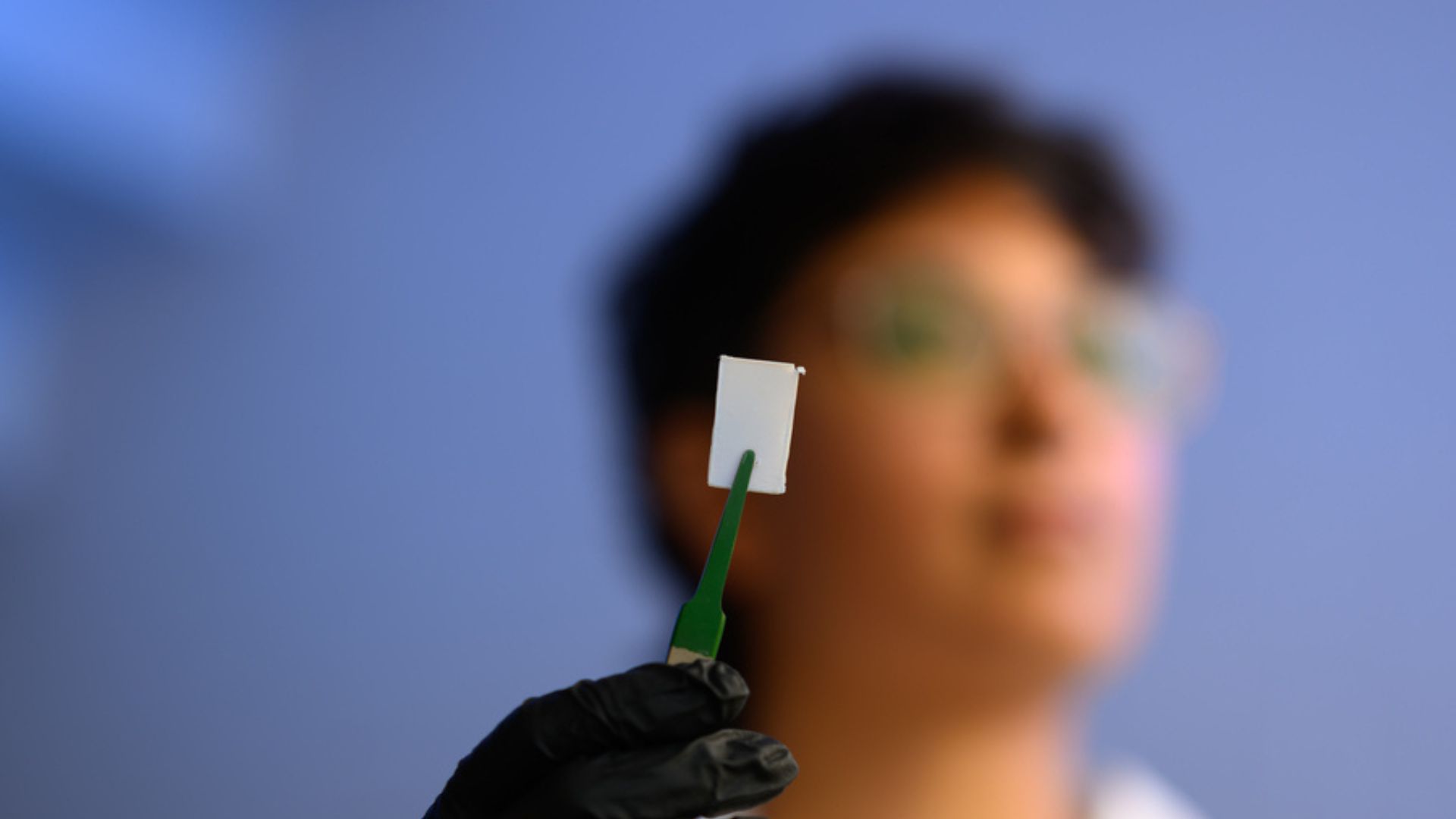
At MIT, doctoral student Palak Patel is harnessing nanotechnology to solve the most daunting hurdles of long-term space exploration.
Patel’s work focuses on Boron Nitride Nanotubes (BNNTs), which offer a solution to one of NASA’s biggest hurdles: ionizing radiation.
At MIT, she works across the Mechanical Engineering and Aeronautics/Astronautics departments, blending large-scale manufacturing logic with atomic-scale synthesis.
BNNTs are tiny, hollow cylinders that might just be the super-material required for the next era of human exploration.
Superpower of nanotubes
Her work focuses on developing advanced nanocomposites designed to shield astronauts from lethal radiation, a primary hurdle for any journey to Mars.
The problem with current spacecraft is their skin. When deep-space radiation hits the standard aluminum used in most hulls, it triggers a splash of secondary neutrons.
These particles are incredibly dangerous for human tissue.
“You can’t safely travel to Mars with the current state-of-the-art materials,” Patel stated, who is a sixth-year doctoral student.
Patel works on the synthesis of nanotubes and the production of multifunctional nanocomposites — hollow, cylindrical architectures prized for their extreme durability and adaptability.
Using a synthesis process developed at MIT, Patel has dramatically increased the density of boron nitride nanotubes within aerospace composites.
While previous limits hovered around 10 percent, her method achieves concentrations of up to 50 percent by weight, creating a lightweight yet formidable shield against space radiation.
This high-performance material offers a solution for deep-space missions, providing essential radiation protection without compromising the spacecraft’s structural or mechanical integrity.
“MIT is the only place where you can synthesize these nanotubes the way we do,” she said. “We’ve got some results that look great.”
Her materials also help wings resist ice, detect structural cracks, and mitigate the abrasive effects of sharp lunar dust.
Samples sent to ISS
Patel’s work is already leaving the atmosphere. In May 2025, she boarded a parabolic flight to test if these nanotubes could be manufactured in microgravity. It worked. Today, her samples are orbiting overhead on the International Space Station (ISS).
As she nears the completion of her PhD, the researcher is tackling the final frontier’s grittier challenges: perfecting thermal protection systems for atmospheric re-entry and neutralizing the abrasive threat of lunar dust.
Drawing lessons from the Apollo missions, she is also developing materials to stop the “sharp and electrostatic” particles that once compromised spacesuits.
Patel aims to enter the space industry during this modern “Apollo moment,” contributing to the historic push to return to the Moon and eventually land humans on Mars.
Inspired by her grandfather (a radiation protection expert in India) and by her childhood “devouring” of space books, she pursued Mechanical Engineering in both India and the U.S.
Before MIT, she interned at ISRO and worked as a project engineer, developing high-precision satellite components.
Beyond her core lab work, she applies her engineering skills to NASA competitions, including a high-stakes project designed to extract water from lunar and Martian surfaces.
When she isn’t synthesizing atoms, Patel is living the analog astronaut life. She recently served as the capsule communicator (CAPCOM) for Asclepios III, an analog mission in the Swiss Alps that simulates the isolation of a lunar base.