It's been a month since the United States and Israel jointly began the Iran war, and Brenna Boyde believes the president's repeated promises to end it have fallen flat.
Boyde is one of a trio of Americans, of different political affiliations, who USA TODAY asked about how their lives have changed since the onset of the conflict. All three largely believe the war caused the high gas and grocery prices that are crippling the nation’s economy. Their views align with the majority of Americans queried in a recent Reuters/Ipsos poll and other surveys.
"I don't think it will ever be over," said Boyde, a declared independent voter who works as an administrator in Darlington Township, Pennsylvania. "I'm not inclined to believe there is a permanent resolution."
Start the day smarter. Get all the news you need in your inbox each morning.
The president initially said the military "excursion" against Iran would last four to five weeks. He later expanded his projection, saying he'd need several weeks to achieve his objectives.
The end can’t come soon enough for Justin Thaemert, a registered Republican from central Minnesota who voted for Trump but has become doubtful the president will deliver on his promise of a quick turnaround.
"I’ll believe it when I see it," Thaemert said.
Auto repair shop owner: It's hard to know what the truth is
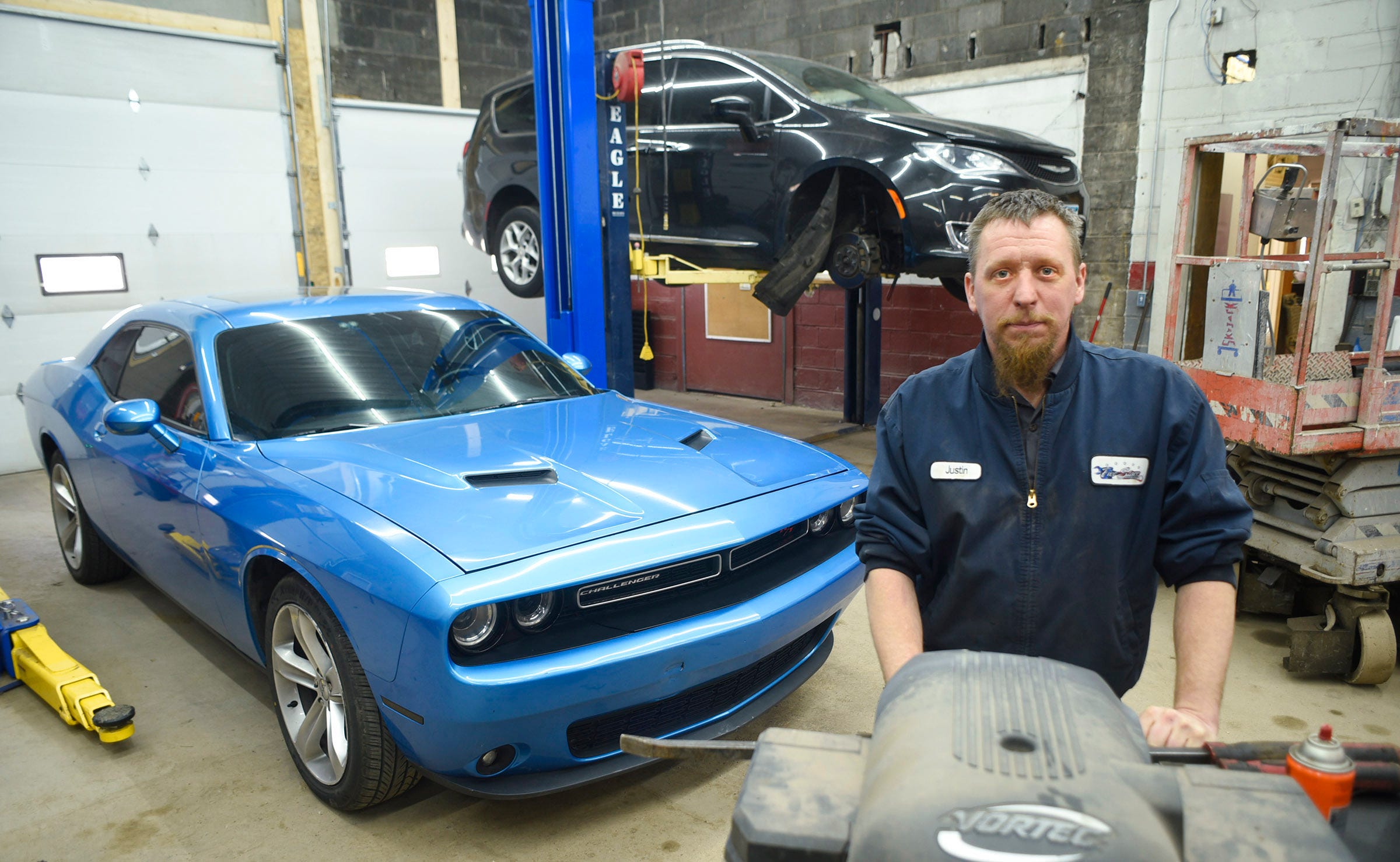
The mechanic bays at Thaemert’s auto repair shop in rural Foley, Minnesota, are idle and may remain that way for a while.
There are fewer cars and pickup trucks to work on. Business was down 60% this winter. He compared it to when people barely left their homes during the pandemic. Business was slow and got even slower when gas prices went up.
Other nearby businesses, Thaemert said, including a nearby car dealership, are seeing a decline in foot traffic.
"Everybody’s kind of tightening their belts," said Thaemert, 35. He started at the Five Starr Auto Repair shop as an employee 15 years ago and became a co-owner about a decade ago. "Folks are putting off repairs and doing other things just to make ends meet. Everything’s at a standstill."
Thaemert voted for Trump for president two years ago. Although he was "on the fence" about the president's take on a lot of issues, Thaemert said he appreciated Trump’s "no BS" and frank approach. He was also sold on the president’s promise to lower taxes and put more money in Americans’ pockets.
But he admits he’s spending more out-of-pocket than he can recall. And he doesn’t know what to make of Trump.
"It’s disappointing. It’s hard for me to tell what the truth is now," Thaemert said. "Everyone wants to spin their own narrative about what’s going on."
Pet care or dinner?
Thaemert, who is raising his teenage daughter in nearby Sauk Rapids, Minnesota, a town of about 14,000 near metropolitan St. Cloud, said he’s also feeling a financial pinch firsthand.
He’s seen gas prices rise to nearly $4 a gallon, a dollar more than a month ago. He’d already seen his grocery bill spike by an extra $300 a month.
And his utility bill could climb again as his provider, Xcel Energy, proposes an 8.7% increase in monthly natural gas costs, roughly $7 more per bill. Thaemert is already paying at least $20 more per month because of two rate hikes last year.
"It’s all adding up," Thaemert said. Instead of celebrating his daughter’s 15th birthday with a big fancy dinner and dessert at a restaurant, he and her mother took her out bowling.
"We can’t do a lot of things right now," Thaemert said. "The money’s just not there."
Then two weeks ago, Kitty, the family’s 13-year-old pre-diabetic cat, had a severe vomiting and rapid breathing episode, Thaemert said.
The local vets were unable to treat Kitty, and Thaemert said they couldn’t afford to drive two hours south, through a major snowstorm, to a vet in Minneapolis, let alone pay the upwards of $2,000 the vet said treatment might cost.
The family had to make some quick and potentially painful decisions, he said.
"We had to make a choice. Do we put $500 to $600 immediately towards the cat, or have enough money to eat?" Thaemert said. "It’s a choice we had to make that we didn’t have to make two years ago."
Luckily, Thaemert said Kitty’s condition improved, allowing the family to breathe easier about her insulin shots.
There are no plans for a family vacation this year, Thaemert said, and if there is any getaway, "it will be very close to home." The family has long decided to put off any home remodeling. Plans for new carpeting, flooring and a bathroom upgrade are on hold indefinitely.
"I’d rather eat than have a new carpet," Thaemert said. "We can’t eat the carpet."
Despite slow business and a higher cost of living, Thaemert said he has no plans to downsize his shop. The two mechanics he employs "aren’t going anywhere."
Just a year ago, the auto bays were backed up with vehicles, Thaemert said.
"If I go look at our schedule, we may sometimes see one, two, maybe five vehicles a week, compared to 15 or 20," Thaemert said. He hopes business picks up this spring, also known as "pothole season."
Thaemert wants the Iran war to be over because all Americans, no matter their political party affiliation, are suffering in some form.
"I’ve never been a fan of war, so I would hope it ends very soon because I’d rather have everybody try to get along," Thaemert said. "Then we can get our country moving again and bring some of these prices down."
Youth counselor skips ordering takeout to buy more gas
The moment Martin Allison heard about the air strikes in Iran, several thoughts raced through his mind.
Are we going to war? How many lives might be lost? How long will it last? And, how fast will gas prices and, well, everything else, go up?
"It was all happening so fast," said Allison, 33, of Torrance, California. "I had to stop and take a breath."
Allison, a registered Democrat, remembers what happened when gas and food prices jumped in Southern California after Russia invaded Ukraine four years ago, as the United States was rebounding from the pandemic. Now, he’s worried about how much this war will impact Americans’ daily lives.
"This will definitely test our resiliency, yet again," Allison said. "Nobody’s really spared this time around."
While he’s trying to keep up with the war’s developments, Allison said he’s unsure why the United States entered into a battle with Iran. He only knows that President Donald Trump told Americans the war wouldn't last long and they would have to endure some short-term pain with their finances.
"Is it all about an agenda, or protecting the people?" Allison said. "I don’t feel like we’ve been given straight answers from this government."
With gas climbing to $7 a gallon and higher across Los Angeles, Allison said the war is having “a trickle-down effect.” He's been scouring the area to find the cheapest gas while juggling two jobs, as a youth counselor for a Boys and Girls Club in nearby Carson and a private fitness trainer. (He’s also an aspiring boxer.)
"Forty dollars barely gives me half a tank," said Allison. "I’m constantly filling up."
The economy is likely weighing more on Americans’ collective psyche than the war in Iran, according to Mark Zandi, chief economist for Moody's Analytics.
"They are focused on that, and the economic conditions affect their perspective on their own financial situations," Zandi said, adding that the nation’s consumer sentiment, which focuses on personal financial situations, inflation and buying attitudes towards household goods, is slowly declining.
Allison, who lives in Torrance, California, said he has to be even more disciplined with his spending. Impulsive shopping is on pause, from random energy drinks to takeout orders while he’s shuttling between gigs.
And he’s coming to grips that a 34th birthday weekend next month in Palm Springs might turn into a day trip with family and friends. And keeping to a strict budget. There are still monthly bills and student loan debt to pay. Giving up Netflix is not in the plans, he said.
Allison said certain aspects of the war pop into his head when he's pumping gas. He's hoping the “short-term pain” is just that, short-term.
He mentions being named after the Rev. Martin Luther King Jr., who preached nonviolence and sought solutions for all. Allison wishes Trump’s continued promises to stop the war soon quickly come to fruition, for everybody’s sake.
"We’re in it now. All you can do is pray and hope for the best for everyone, the troops and their families, their kids," Allison said. "I’m just praying for everybody’s safe return home. The sooner, the better."
Taking a more humanitarian approach to the war
Boyde, a mother of three in a tiny Pittsburgh suburb, isn’t angry that President Trump entered the war.
"I am more annoyed with him," Boyde, 42, said. "I’m very annoyed about the way he went about doing it. It just felt kind of impulsive and very irresponsible, and now many, many lives are being affected by that decision."
Boyde lives in Beaver County near the Pennsylvania-Ohio border, where it’s not uncommon to see American flags outside homes, and everybody knows each other, their parents and their grandparents, Boyde said. Those close-knit ties are why Boyde and her husband are trying to take “a more humanitarian approach” to the war.
Instead of venting their frustrations, Boyde said they have chosen to channel their energy towards the safety of the service members risking their lives, and their loved ones who seek their safe return home. It’s a healthier coping mechanism, Boyde said.
"My husband and I say we can’t control this, but we think about the people who are fighting in the conflict and their families, and how that impacts not just us, but other Americans and people in the world," Boyde said, pausing to collect her thoughts. "It’s a hard balance, it’s just, there’s no sense in getting all stressed out about the prices of things like food and gas.
"I can find better ways to voice my opinion, asking why we are doing this in the first place," Boyde added, noting she’s directed her concerns to Congressman Chris Deluzio, a progressive Democrat and an Iraq War veteran.
Deluzio was one of six Democratic lawmakers and military vets, including Sen. Mark Kelly of Arizona, whom the Justice Department tried to indict for their appearance in a controversial November 2025 video titled "Don’t give up the ship," telling service members they have the right not to obey orders they believe are illegal.
Shuttling kids to practice at $4 a gallon
A month into the war, Boyde and her family are making some adjustments, such as buying more meat and dairy from local farmers and vendors rather than paying more at a grocery store.
"We live in our minivan on weekends. It’s worth every cent and every moment. We wouldn't change it for anything in the world," Boyde said. She added that they've cut costs by prepacking the kids’ snacks and meals instead of frequenting fast food restaurants.
However, they can’t avoid paying $4 a gallon for gas, as they have to shuttle all three of their kids to soccer practices and games, sometimes more than an hour away.
Boyde admits the long drives recently have had her thinking more about the war. She’s still trying to grasp what exactly started the conflict.
"Maybe we’ll never know why," Boyde said. She hopes the war reaches a resolution soon. "All I know is that I don’t want this war to be in vain, and for it to go on for years."
"I feel there was an irresponsible start to this war," Boyde concluded. "But I don’t want it to have an irresponsible end."
This article originally appeared on USA TODAY: When will the Iran war end? Not soon enough, some Americans say