Scientists have uncovered a link between a mysterious burst of red-stained water in Antarctica and a drop in the glacier sitting above it.
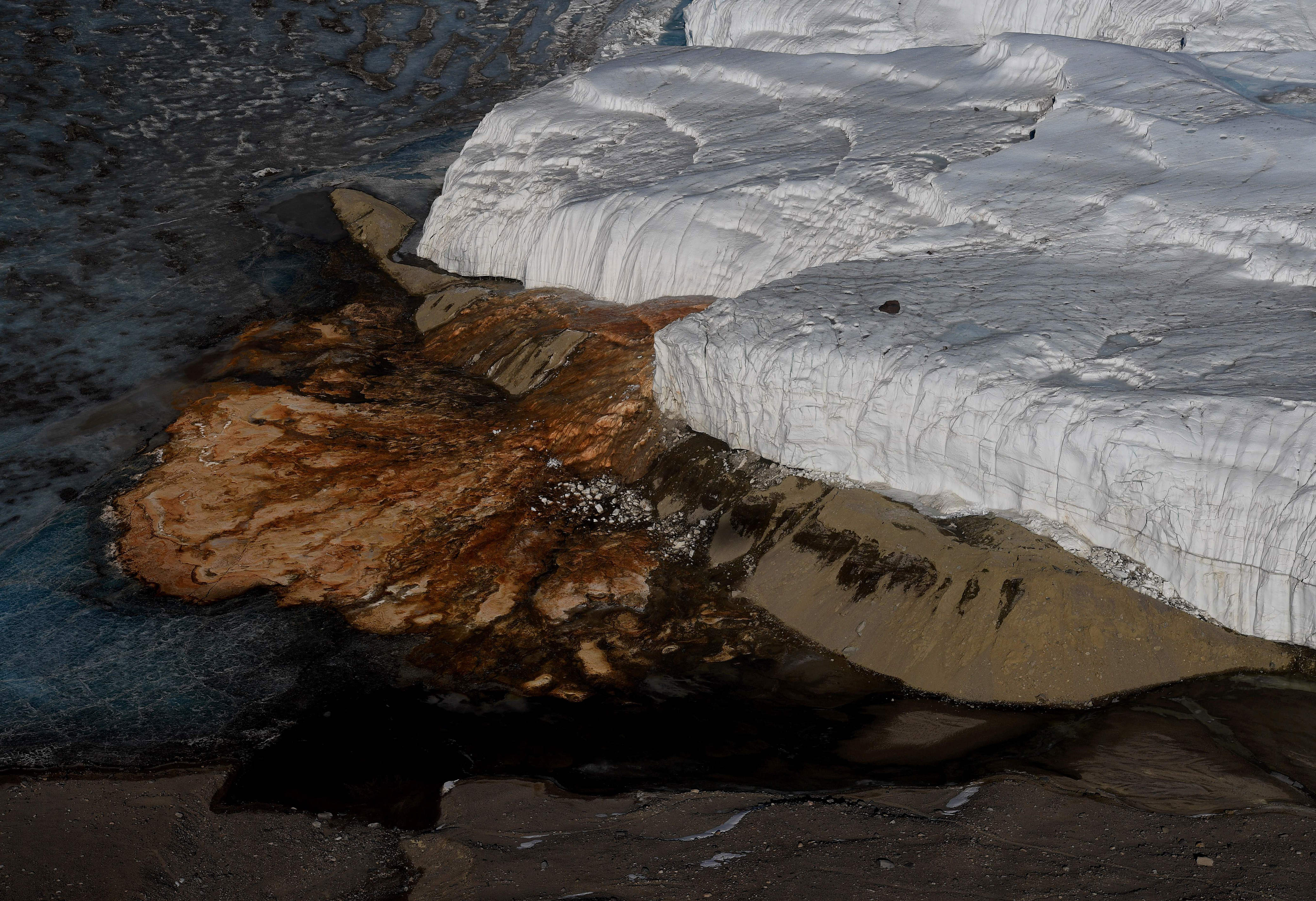
The Blood Falls in Antarctica are a unique feature found at the nose of the Taylor Glacier, a large river of ice that flows through the McMurdo Dry Valleys of eastern Antarctica.
The unusual phenomenon was first discovered in 1911 by Australian geologist Thomas Griffith Taylor during the Terra Nova Expedition to Antarctica.
“It is an iron-rich brine that occasionally gets expulsed from a subglacial source due to the weight and movement of the overlying glacier,” explain the researchers in their study. This stains the glacier as it oxidizes at the surface and flows towards the West Lobe of Lake Bonney (WLB), an ice-covered Antarctic lake.
The team’s study suggests that this brine is more than just a surface stain and signals a change in pressure, along with hidden water movement deep below the ice of the glacier.
Peter T. Doran, a geoscientist at Louisiana State University and lead author of the study, matched the drop in the glacier to the outflow and connected it to lower pressure.
Over several weeks, Doran and his team saw the surface of the glacier sink and later recover, suggesting a drainage pulse under the glacier.
Back in September 2018, “a serendipitous alignment of observations” was made based on data from a GPS tracker on the surface of the Taylor Glacier, a time-lapse camera recording of the Blood Falls, as well as a thermistor in the WLB, which is a sensor that detects temperature change, the researchers said.
Camera footage recorded daily around Lake Bonney showed fresh staining beginning on September 19, 2018, and the stain area expanded. Meanwhile, a lake thermistor recorded a drop at depth during the same discharge event.
When heavy ice traps salty water beneath it, pressure builds and the glacier cannot hold such forever. The liquid that makes Blood Falls comes from subglacial channels found beneath a glacier and sealed from air that can open during ice movement. The weight and slow movement of the ice can push the salty mix toward cracks, where it’s released in sudden pulses.
The latest study observed a 0.6-inch drop in the surface of the glacier, while its forward motion was reduced by around 10 percent.
“These observations demonstrate that an extended brine discharge event, characterized by episodic pulses of brine sourced from beneath Taylor Glacier over ~1 month, reduces subglacial water pressure, which lowers the surface and reduces ice velocity,” the researchers wrote.
They added: “Continued (and spatially expanded) high-frequency glacial and limnological monitoring will provide a robust dataset capable of enabling the detection of changes in the frequency and magnitude of events driven by long-term environmental change.”
Do you have a tip on a science story that Newsweek should be covering? Do you have a question about glaciers? Let us know via science@newsweek.com.
Reference
Doran, P. T., Siegfried, M. R., Dugan, H. A., Hubbard, K. A., & Lawrence, J. P. (2026). Glacier surface lowering and subglacial outflow coincide with Blood Falls discharge in the McMurdo Dry Valleys. Antarctic Science. https://doi.org/10.1017/S0954102025100527
Related Articles