
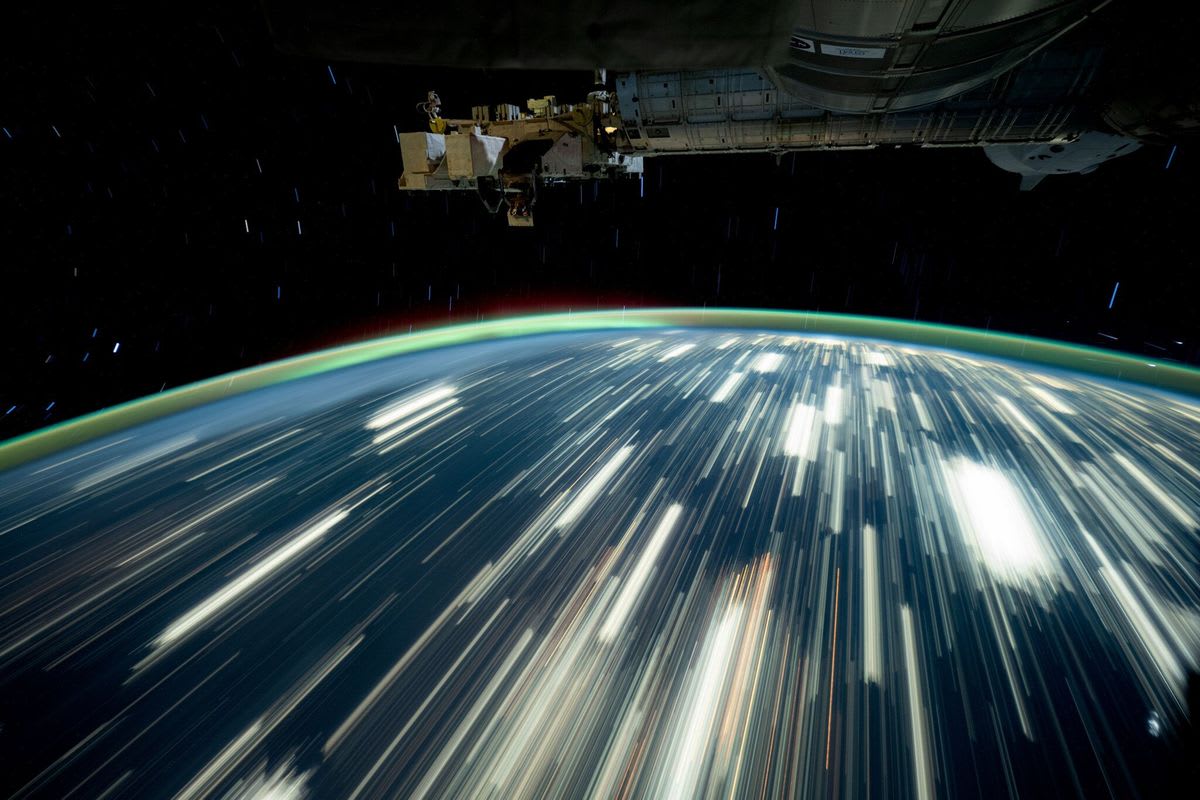
Earth's spin is slowing down and our days are getting ever-so-slightly longer. While the planet's rotation often speeds up and slows down over time, new research suggests the current increase in day length is unprecedented in at least 3.6 million years of history.
In theory, it takes 24 hours for Earth to complete one rotation. In reality, a day can run a little long or a little short, nudged by the gravitational pull of the Moon and several geophysical processes playing out deep within Earth's interior, at its surface, and high in the atmosphere. This is precisely what happened in July and August 2025 when the proximity of the Moon caused Earth’s days to be just over 1 millisecond slower than average.
However, a much larger trend is also afoot. Human-driven climate change is warming the planet and melting its ice sheets, unlocking water that has been frozen for millennia. As that water thaws into liquid and spreads across the globe in the form of rising seas, it redistributes Earth's mass. In doing so, it’s gradually putting the brakes on its spin, lengthening the days by milliseconds.
It’s similar to the way a figure skater will spin more slowly when they extend their arms outwards. When ice sits atop polar landmasses, it is concentrated near the axis around which Earth spins. As it melts and flows into the oceans, that mass spreads outward toward the equator, moving further from Earth's rotational axis.
In a new study, scientists from the University of Vienna and ETH Zurich set out to determine just how unusual this slowdown is by looking at millions of years of Earth's history since the Late Pliocene.
"In our earlier work, we showed that the accelerated melting of polar ice sheets and mountain glaciers in the 21st century is raising sea levels, which slows Earth's rotation and therefore lengthens the day — similar to a figure skater who spins more slowly once they stretch their arms, and more rapidly once they keep their hands close to their body," Mostafa Kiani Shahvandi, study author from the University of Vienna’s Department of Meteorology and Geophysice, said in a statement.
"What remained unclear was whether there were earlier periods when climate increased day length at a similarly rapid pace."
The team concluded that Earth’s day is currently lengthening at about 1.33 milliseconds per century, primarily due to sea-level rise from melting ice redistributing mass and slowing Earth's rotation.
This, they found, was happening at an unprecedented rate compared to any other time over the past 3.6 million years. And it’s unlikely to be the end of the story. With further warming and ice sheet melting expected in the decades ahead, the effect is only set to grow.
"This rapid increase in day length implies that the rate of modern climate change has been unprecedented at least since the late Pliocene, 3.6 million years ago. The current rapid rise in day length can thus be attributed primarily to human influences," added Benedikt Soja, Professor of Space Geodesy at ETH Zurich.
“By the end of the 21st century, climate change is expected to affect day length even more strongly than the Moon. Even though the changes are only milliseconds, they can cause problems in many areas, for example, in precise space navigation, which requires accurate information on Earth's rotation," Soja notes.
Fortunately, you're unlikely to feel 1.33 milliseconds slip by in your day over the span of many years. However, it could cause some hiccups for technology that depends on precise timekeeping, such as GPS satellites and complex financial networks, where even the tiniest drift in Earth's rotation can mess up a carefully calibrated system.
The new study is published in the Journal of Geophysical Research: Solid Earth.