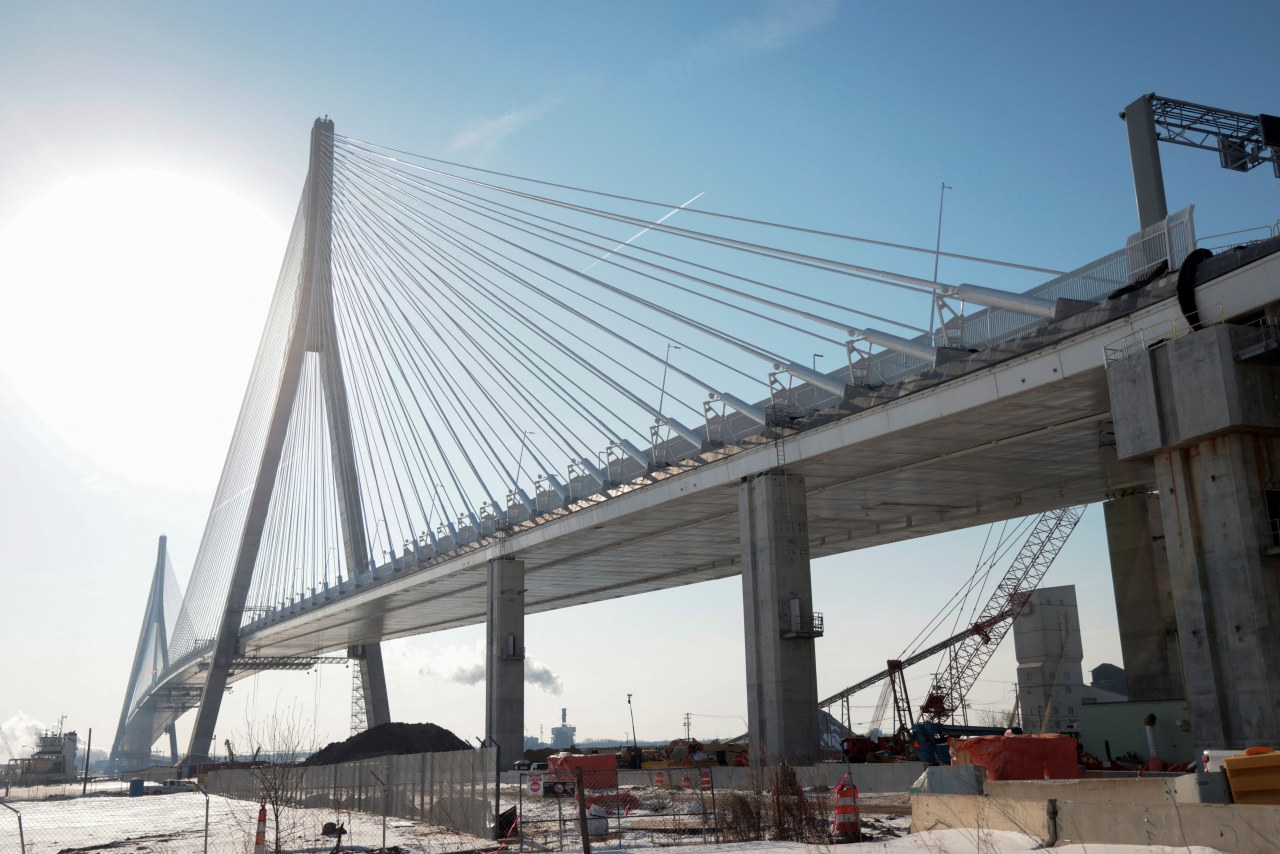
OTTAWA—Prime Minister Mark Carney said Canada and the Trump administration would work to resolve a dispute over a new bridge connecting the two countries, a sign of how the U.S. leader’s frequent threats might be losing their bite with some of his foreign counterparts.
The fight over the soon-to-be-opened Gordie Howe International Bridge was the third economic threat President Trump has lobbed against Canada in the span of a month, after Carney struck a limited trade pact with China and delivered a speech at Davos calling on smaller powers to fight economic coercion.
On Monday, Trump threatened to block the opening of the new bridge that would connect Detroit and Windsor, Ontario, and help alleviate truck-traffic congestion on North America’s busiest commercial land crossing. In a Truth Social post, Trump said the U.S. should be given an ownership stake of at least 50% in the Gordie Howe International Bridge, and complained about the quantity of U.S. products, like steel, used in the construction of the 1.5-mile corridor.
Carney said Tuesday he spoke with Trump to inform him Canada paid for the construction of the new corridor, and that Michigan already has an ownership stake. Carney said he also informed Trump that U.S. steel and U.S. labor were used in the bridge’s construction.
Carney said he and Trump agreed to follow up on certain issues, in parallel with trade talks, although he declined to elaborate. “This is going to be resolved,” he said.
White House press secretary Karoline Leavitt said Trump’s demand “is just another example of President Trump putting America’s interests first,” which he made “very clear in his call with Carney.”
Donald Abelson, a politics professor at McMaster University in Hamilton, Ontario, said Carney’s approach reflects a cautious-yet-firm tone that he and some other global political leaders are beginning to adopt when it comes to Trump.
“Carney’s message is that we are prepared to work with you, and we are prepared to negotiate. But we will not permit ourselves to be bullied,” said Abelson.
Europe sent a similar signal recently as countries pushed back against Trump’s demand for Greenland. Trump eventually backed off, citing the framework for a new trans-Atlantic deal over the island.
Construction on the new bridge began in 2018, and it is set to open sometime in 2026, according to the Windsor-Detroit Bridge Authority, the Canadian-government agency tasked with managing the corridor. The new bridge would operate alongside the privately held Ambassador Bridge and the Detroit-Windsor Tunnel.
Commerce Secretary Howard Lutnick met on Monday with Matthew Moroun, whose family has operated the Ambassador Bridge, according to a Trump administration official. After the meeting, Lutnick believed the U.S. was receiving an unfavorable deal on the bridge and made that clear to the president, the official said. The meeting was first reported by the New York Times.
Since coming to power last year, Carney has made it a priority to reduce Canada’s reliance on trade with the U.S., through the development of the country’s resources and the construction of new infrastructure to allow for increased shipments to Asia and Europe. Before 2025, about 20% of the country’s economic output was tied to two-way trade with America.
Eric Miller, a former senior Canadian official and now a Washington-based trade consultant, predicted Carney won’t budge on Trump’s bridge demands, citing a 2012 agreement between the state of Michigan and Canada over the bridge. Canada agreed to shoulder nearly all of the construction costs, which it would later recoup from tolls levied on the Canadian side. Both Canada and Michigan have ownership stakes in the 1.5-mile corridor.
“Carney can point to the bridge dispute as Exhibit A of how economic integration will lead to coercion,” said Miller, in reference to a passage from Carney’s speech in Davos.
In his speech last month at the World Economic Forum in Davos, Switzerland, Carney said Canada and other countries can increase their leverage against great powers like the U.S. and China by boosting their domestic economy and diversifying their export markets.
Besides vowing to hold up the opening of the bridge, Trump has recently threatened to impose 100% tariffs on all Canadian exports should Carney secure a free-trade agreement with Beijing, and decertify aircraft made by Montreal-based Bombardier unless Canadian authorities accelerate regulatory approval of the latest models produced by Gulfstream, a unit of General Dynamics.
Canadian officials have repeatedly said they have no interest in pursuing a free-trade pact with China. The deal Beijing and Ottawa cut is limited to allowing some Chinese electric vehicles into Canada at a sharply lower tariff rate and reducing Chinese duties on Canadian agricultural products.
Write to Paul Vieira at Paul.Vieira@wsj.com