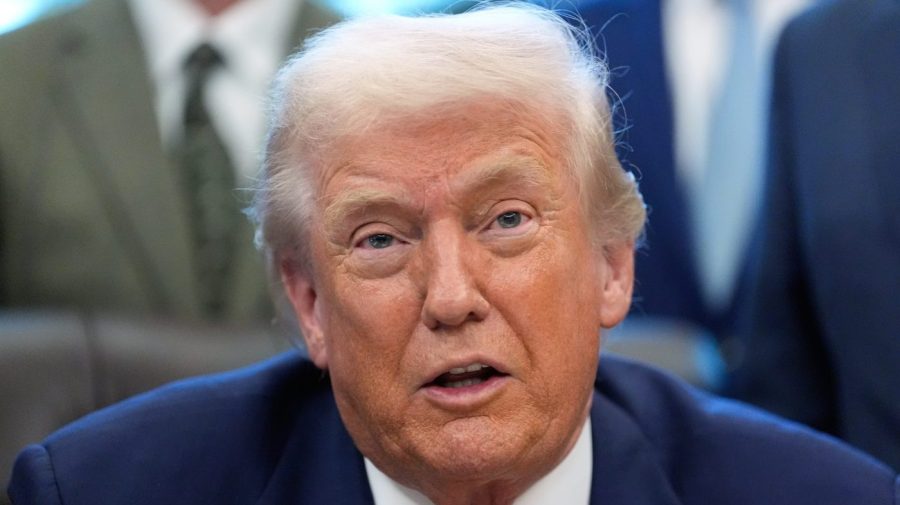
WASHINGTON – Making a case for why the Supreme Court should overturn a $5 million judgment that President Donald Trump sexually abused and defamed the writer E. Jean Carroll, the president’s lawyers topped their legal arguments with a practical one.
He’s busy.
“It is deeply damaging to the fabric of our Republic for President Trump, in the midst of a historic presidency, to have to take his focus away from his singular and unique duties as Chief Executive to continue fighting against decades-old, false allegations and the myriad wrongs throughout this baseless case,” his lawyers wrote in their final filing before the high court decides as soon as this month whether to hear Trump’s appeal. "This mistreatment of a President cannot be allowed to stand."
Start the day smarter. Get all the news you need in your inbox each morning.
The brief, however, was filed the same week that Trump sued the Internal Revenue Service for $10 billion over the leak of his tax information.
In the past year, Trump has also filed defamation lawsuits against The Wall Street Journal, The New York Times and the BBC.
“One who races to the courthouse door to sue should not be heard to say that they are too busy to answer any suit,” said Mitchell Epner, a former New Jersey federal prosecutor.
'Trump is in a league of his own'
The extent to which Trump has relied on defamation and other civil lawsuits is unprecedented, according to William & Mary Law School professor Timothy Zick.
“No other political candidate or president has wielded the civil lawsuit as a political sword quite as Trump has,” Zick recently wrote. “When it comes to civil litigation, Trump is in a league of his own.”
Trump was already famous for his legal skirmishes over everything from his golf courses to his tax bills to Trump University before his first term as president.
A 2016 USA TODAY analysis of legal filings across the United States found Trump and his businesses had been involved in at least 3,500 legal actions in federal and state courts during the previous three decades. Lawsuits were one of his primary negotiating tools. And he was also often sued by others.
What did E. Jean Carroll allege in her lawsuits?
Carroll’s case against Trump began after she said in 2019 that Trump sexually assaulted her at a New York City department store in 1996. Trump fired back with allegations that she was making up the story to sell her book.
Carroll sued him for defamation months later, eventually winning an $83.3 million judgment, which Trump continues to fight.
As the case was ongoing, Trump repeated his denial of the assault in a 2022 social media post. Carroll then sued Trump again under a special window of time that New York granted to sexual abuse survivors, and in 2023, a New York jury found Trump liable for defamation and for sexual abuse against Carroll. This resulted in the $5 million verdict that Trump wants the Supreme Court to overturn.
Appeals court ruled against Trump
His lawyers argue that the jury should not have been allowed to hear from two other women who alleged Trump assaulted them or to review the 2005 “Access Hollywood” recording of Trump bragging about grabbing women by their genitals.
The New York-based 2nd U.S. Circuit Court of Appeals rejected Trump's argument that the trial judge erred in permitting that evidence. And even if the judge got it wrong, the appeals court ruled in 2024, “taking the record as a whole and considering the strength of Ms. Carroll's case, we are not persuaded that any claimed error or combination of errors in the district court's evidentiary rulings affected Mr. Trump's substantial rights.”
Neama Rahmani, a Los Angeles-based litigator and former federal prosecutor, said the evidentiary complaints raised by Trump’s lawyers aren’t the types of issues the Supreme Court tends to take up.
The fact that it’s Trump appealing means there’s some chance that the court will consider it, Rahmani said.
“Still, it’s a small chance,” he added.
Is the Paula Jones lawsuit against Bill Clinton relevant?
As for Trump’s argument that the lawsuit is a distraction from his presidential duties, the Supreme Court spoke to that issue when ruling in 1997 that a sexual harassment lawsuit brought by Paula Jones against President Bill Clinton did not have to be put on hold until Clinton left office.
While acknowledging the unique responsibilities of the presidency, the court nonetheless unanimously said there were ways of accommodating the president’s arduous schedule.
“We recognize that a President, like any other official or private citizen, may become distracted or preoccupied by pending litigation,” Justice John Paul Stevens wrote. “Presidents and other officials face a variety of demands on their time, however, some private, some political, and some as a result of official duty.”
This article originally appeared on USA TODAY: Too busy? Trump's unusual Supreme Court push to toss E. Jean Carroll case