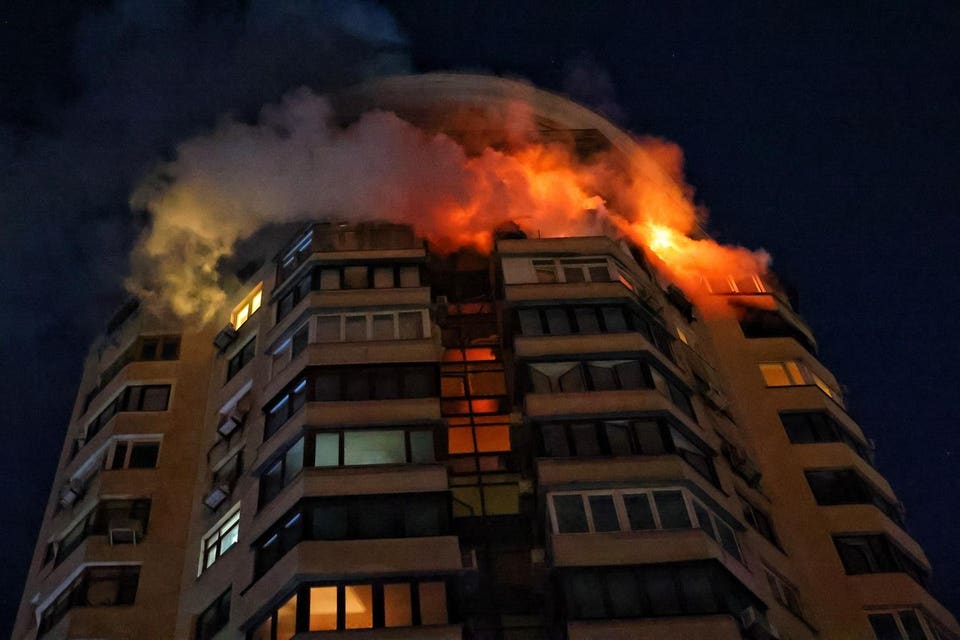
With the fourth anniversary of Russia’s full-scale invasion of Ukraine around the corner, Moscow targeted one of its largest missile attacks at Ukrainian power plants amid a brutal February freeze. Thousands and thousands of people in Ukrainian cities have been struggling to survive in freezing temperatures, without heat, amidst blackouts and relentless bombing.
The U.S. continues to play an active role in negotiations to end the four‑year war. With the lack of clear progress, the Trump administration will likely put pressure on both sides to reach a deal.
How does the war end when a powerful ally pressures the attacked country to compromise, despite all evidence showing the attacker’s actions over the past four years meet every definition of genocide?
To be clear, the U.S. Department of Justice defines genocide as “the deliberate, systematic destruction of a national, ethnic, racial, or religious group, defined by five specific acts committed with intent to destroy the group in whole or in part.” The 1948 Genocide Convention specifies “killing members, causing serious bodily or mental harm, imposing conditions of life meant to destroy the group, preventing births, and forcibly transferring children. Russia has been doing all this to Ukrainians for the past two years, out in the open, including forcibly transferring children, torture, rape, and mass killings of civilians, as evidenced by mass graves discovered in formerly occupied territories.
In January and February in Ukraine’s capital of Kyiv and its second largest city, Kharkiv, temperatures reached -13 F (-25 C). Russia’s massive ballistic missile and drone attack left thousands of people without electricity and heat in Kyiv, Kharkiv, Zaporizhzhia, and other places. Russia is deliberately hitting Ukraine’s power grid during the coldest weeks, causing intentional harm to the civilians, killing the most vulnerable members of society — the ill, disabled, elderly, poor —those who can’t leave, and don’t have access to power generators.
The United States could play a defining role in ending this war and securing long-lasting peace in Europe and beyond.
Trilateral talks between the U.S., Russia, and Ukraine in Abu Dhabi, UAE, did not bridge all the gaps between the parties’ positions. Numerous factors surrounding Russia’s actions seem to be missing from the picture and get in the way of the Trump administration’s efforts: global security threats and the existential interests of countries beyond Ukraine.
Ukraine and global security were central to discussions at the World Economic Forum in Davos in January, including meetings at Ukrainian House Davos, co-organized by the Ukraine-Moldova American Enterprise Fund, the Victor Pinchuk Foundation, and Horizon Capital.
“For most Europeans, Ukraine is currently the number one security challenge,” said Wolfgang Ischinger, Chairman of the Munich Security Conference, while moderating the discussion “The Role of the United States in the World" at Ukrainian House Davos. “It’s not only about helping Ukraine, making sure that Ukraine is not going to lose this conflict… but that this war is actually about us, about all of Europe, about our existential interests.” The talks, hosted by Victor Pinchuk’s foundation and PinchukArtCentre in cooperation with the Office of the President of Ukraine, included retired Lieutenant General Keith Kellogg, the former U.S. Special Envoy for Ukraine.
Kellogg addressed Europe’s role in ending the war, arguing that European countries underestimate their collective strength. “I do believe that Europeans and Europe are much stronger than they think,” he said. “They have relied for 75 years on the fact that Americans are going to be there for them. And we are going to be there. We are always going to be there.” But he added that Europe’s growing capabilities could influence Russia’s calculations: “If Europeans get their act together, they will be very, very strong collectively.”
Asked about the prospects for peace, Kellogg said the conflict may be approaching a decisive phase. “I think we are heading, maybe, towards the last stages of peace developments,” he said. He suggested that progress could come after the cold season. “Ukraine has got to get through this winter, and then the advantage flows back to you. And I think that Putin will see that, and I think that over time he cannot sustain this.”
Kellogg contrasted the motivations of the two armies. “Putin has got an army that is filled primarily with the people he is paying off,” he said. “Ukraine has got an army that is fighting for its nation.” He rejected proposals to trade territory for peace, specifically the idea of giving up Ukrainian-controlled parts of Donetsk region. “I’m one of those guys who doesn’t believe that giving up the land in Donetsk is the right idea,” he said. “If you give up that land, it is wide open to Kyiv after that.”
He also called on Ukrainians who left the country to return. “You have got to stay in the fight for your country,” Kellogg said. “Regarding the fact that so many people left, they need to come back and fight for it. And they will actually build a better Ukraine than it was before.” He said Ukraine’s future capacity is clear. “When you look at the technology and the growth of the people in Ukraine, you realize that it will be an exceptional and powerful nation.”
Both speakers identified Russia as the main obstacle to peace. “The real impediment to progress is Putin,” Kellogg said. Ischinger called for stronger measures, including the use of frozen Russian assets. “It would have been highly desirable for EU partners to get their act together and actually decide to take these so-called frozen assets and use them directly,” he said, noting the potential impact on Russia’s calculations.
The discussion concluded with the view that ending the war requires sustained pressure on Russia, unity among European states, continued U.S. engagement, and rejection of territorial concessions.
Steve Witkoff, U.S. Special Envoy to the Middle East and U.S. negotiator for the Ukraine peace process, spoke at the Ukrainian Breakfast Davos (a private annual discussion, which this year featured NATO Secretary-General Mark Rutte and multiple European heads of state). “The President [Trump] talked about a tariff-free zone for Ukraine, which I think will be game-changing, and you’ll see the industry moving into that area,” he noted.
Speaking to reporters on February 6, Zelenskyy said Russia presented the U.S. with a $12 trillion economic proposal, as bilateral economic deals with the U.S. form part of the broader negotiating process.
“Peace talks are great and fantastic, and we’ll do everything to conclude them successfully”, Mark Rutte, Secretary-General, NATO, stated in Davos. “But that will not happen tomorrow. And meanwhile, they [Ukrainians] need interceptors and military support tomorrow. So, my European and Canadian friends, we have to stay focused.”
President of Finland Alexander Stubb, whose country joined NATO in 2023 fearing Russia’s expansionism, said: “The big dilemma that we are facing right now is how to force Russia end this war. And there are only two things that we can do. The first one is to continue to provide Ukraine with everything it possibly needs. And the second one is to put more economic pressure on Russia. And then we will see that Ukraine will have won this war at the end of the day,” he added.
Since the beginning of 2026, the Russian government has continued to bomb Ukrainian cities and energy infrastructure, killing civilians and causing a humanitarian crisis during the brutal winter cold. There is no ceasefire, and there have not been any mentions of consequences for Russia’s war crimes and atrocities in the peace negotiations reports.