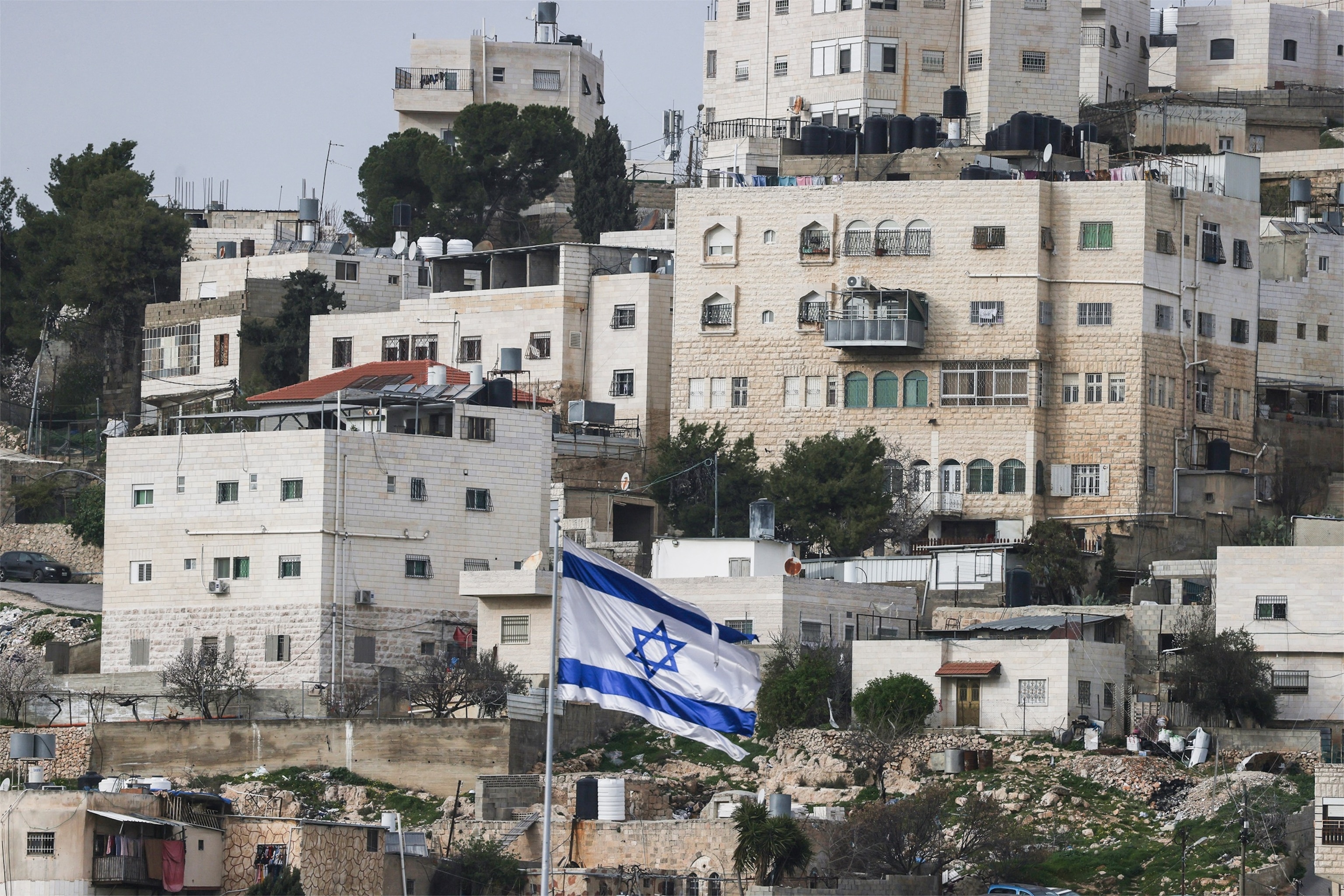
LONDON and TEL AVIV -- The Israeli government adopted a series of significant, bureaucratically complex measures that would allow Israelis and Jews abroad to more easily purchase and build on land in the West Bank, consolidating Israeli control in the area that would potentially serve as the heartland for a future Palestinian state.
The measures, which were approved over the weekend, are likely to be challenged in the Israeli Supreme Court. But they represent the most far-reaching attempts by Prime Minister Benjamin Netanyahu’s right-wing government to advance a de-facto annexation of the West Bank.
The Palestinian Authority, the governing body for Palestinians that already has only limited powers in the West Bank, described the moves as an "unprecedented escalation" and "illegal," views echoed by regional Arab states.
U.S. President Donald Trump has previously said the U.S. opposes attempts by Israel to annex the West Bank, a long-held dream of some settler groups and far-right ministers who now hold powerful positions in Netanyahu’s government.
The newly adopted measures are expected to deepen Israeli civil -- as opposed to military -- control of new areas within the West Bank, including key religious sites in Hebron, and are designed to make it easier for Israelis to buy land in the territory.
Israel's Security Cabinet, headed by Netanyahu, approved on Sunday a series of new measures that would lift a ban on the sale of land to private Israeli Jews, transfer construction authority at religious and sensitive sites in the city of Hebron to the Israeli government, and declassify land registry records.
The United Nations condemned the measures, with a spokesperson for the secretary-general saying in a statement that "all Israeli settlements in the occupied West Bank, including East Jerusalem, and their associated regime and infrastructure, have no legal validity and are in flagrant violation of international law, including relevant United Nations resolutions."
The measures would allow the Israeli government to operate under the guise of civilian issues in Palestinian areas A and B for the first time, which contravenes the Oslo Accords. Under the Oslo Accords, the Palestinian Authority is the sole authority responsible for civilian matters in Area A and B. Israel, in contrast, has full Israeli civil and security control over Area C, which represents about 60% of the West Bank.
Bezalel Smotrich, Israel's far-right, pro-settlement finance minister, hailed the move as an "historic day for settlement for Judea and Samaria," as parts of the West Bank are known in Hebrew.
He said the changes would "fundamentally change the legal and civil reality." He boasted that it would end the prospects for a potential Palestinian State.
Netanyahu has vowed that a Palestinian state "will not be established," even as Western countries, including France, Canada and the United Kingdom, have moved to recognize a Palestinian state.
The office of the Mahmoud Abbas, the president of the Palestinian Authority, issued a statement condemning the measures as "dangerous decisions" designed to "deepen attempts to annex the occupied West Bank."
The president's office said the move was a "blatant violation" of the Oslo Accords, which divided the West Bank into Areas A, B and C, adding that the move represents an "unprecedented escalation targeting the Palestinian presence and its national and historical rights throughout the Palestinian territory."
Abbas' office described the move as illegal and called for the U.S. and the European Union to intervene.
A joint statement by the foreign ministers of eight Muslim countries condemned the new measures.
The foreign ministers of Saudi Arabia, Jordan, Qatar, Indonesia, Egypt, Turkey, Pakistan and the United Arab Emirates said in a statement posted on social media that they collectively "condemned in the strongest terms the illegal Israeli decisions and measures aimed at imposing unlawful Israeli sovereignty, entrenching settlement activity, and enforcing a new legal and administrative reality in the occupied West Bank, thereby accelerating attempts at its illegal annexation and the displacement of the Palestinian people."
"They reaffirmed that Israel has no sovereignty over the occupied Palestinian territories,” the statement added.
According to Peace Now, an Israeli settlement watchdog and activist nongovernmental organization, the measures adopted over the weekend would effectively mean that Israeli authorities can now carry out legal demolitions of Palestinian property in Areas A and B, which comprise around 40% of the West Bank and which under the Oslo accords have been governed by the Palestinian Authority.
While the Israeli military could operate in those areas as the occupying power, the "government is now seeking to ignore its international commitments and begin administrative operations inside areas of the Palestinian Authority. Under the Oslo Accords, Israel has operated militarily in PA areas since the early 2000s," the watchdog said.