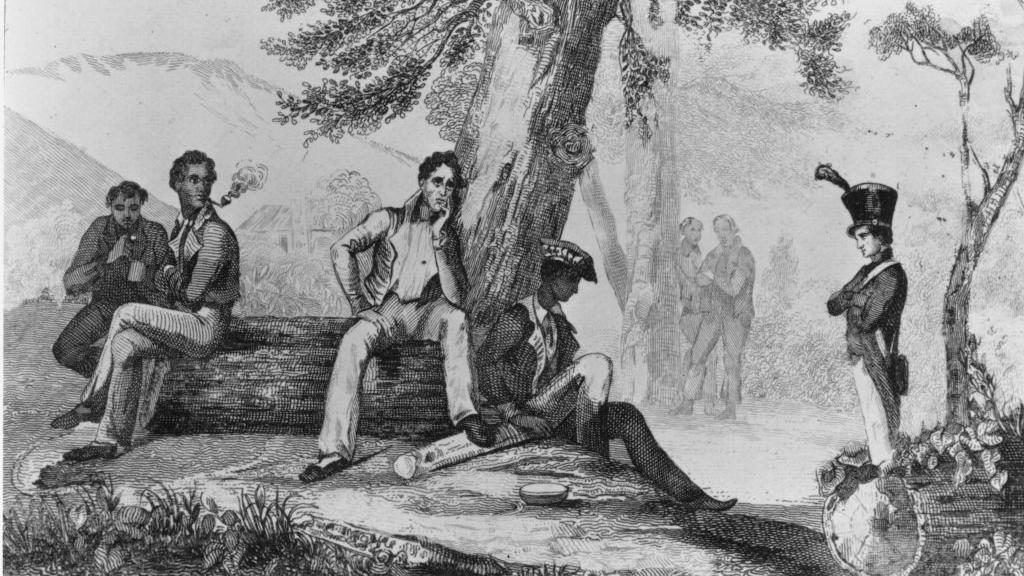
Between the 18th and 19th Century extreme poverty was prevalent in all corners of British society and the government came up with a plan to reduce the population of the poor, according to a historian.
Neil Tonge said many poor people and criminals were transported to Australia, which was identified as a penal colony at the time.
"Most of the crimes were stealing food," he said. "It was a time of great hardship and people stole in order to survive.
"There was a plan to get rid of poorer members of society as there was a great fear that they would overwhelm the well-off."
He said stealing goods worth more than one shilling, equivalent to 5p today, was regarded as a crime "worthy of being transported".
Mr Tonge added decommissioned ships were moored on the River Medway to detain prisoners destined to be banished Down Under.
"Unaccompanied children, as young as eight, were also sent to Australia," the historian said.
"There was a recorded case of a prisoner who was given a choice to be sent to Australia or be hanged - they chose to be hanged instead."
Mr Tonge added prison overcrowding was another reason the authorities chose this course of action.
According to the National Museum of Australia, more than 162,000 British and Irish convicts were shipped to Australia between 1788 and 1868.
The so-called First Fleet, which comprised 11 ships transporting more than 700 convicts, sailed from Portsmouth to Botany Bay in New South Wales.
Following the perilous eight-month journey, a convict settlement was established at Sydney Cove.
Mr Tonge said initially the United States was the main destination to transport convicts but it was no longer an alternative following the war of independence (1775 to 1783).
Mr Tonge said the government therefore had to look elsewhere, and Australia was selected.
"Conflict between the First Nations people and the white population was horrific," Mr Tonge added.
"A lot of the indigenous populations in Tasmania were hunted down and killed."
While many arrivals struggled to survive the alien landscape of Australia and the isolation, as well as the brutal penal system, some settlers had managed to prosper.
"One of them was D'Arcy Wentworth, who was a member of the gentry," Mr Tonge said.
Wentworth was accused of robbing stagecoaches, and although he was acquitted he voluntarily boarded the Second Fleet in 1790 to Australia.
He became a surgeon, superintendent of police, and one of the founding members of the Bank of New South Wales.
"Many of the convicts who went to Australia did subsequently prosper, but they had to be enterprising to survive in that sort of society at the time," Mr Tonge said.
The historian said transportation continued until 1868.
Follow BBC Kent on Facebook, on X, and on Instagram. Send your story ideas to southeasttoday@bbc.co.uk or WhatsApp us on 08081 002250.