The Trump administration is making moves to loosen the environmental rules for nuclear energy.
Earlier this month, the Energy Department published an exclusion to environmental reviews for the reactors under its jurisdiction. And it could be loosening other rules, including radiation limits.
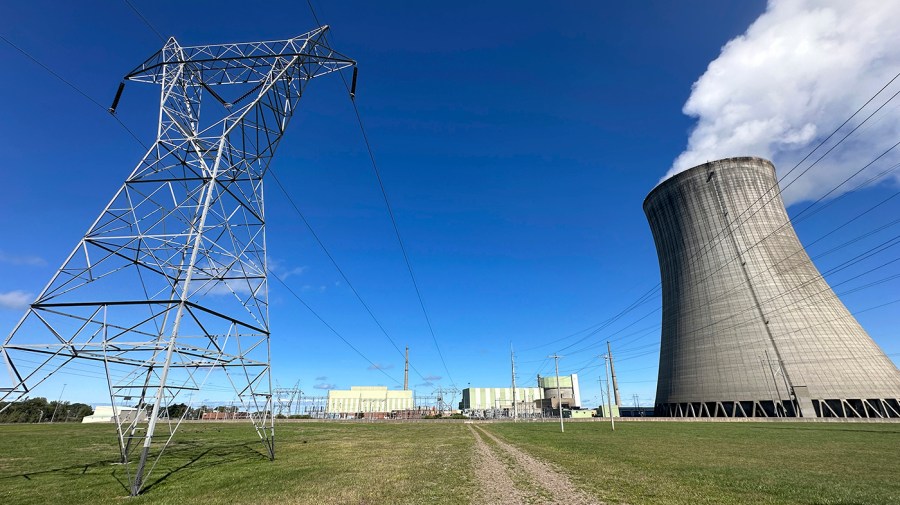
But the biggest changes could be still to come from the relatively low-profile Nuclear Regulatory Commission (NRC), which is in charge of the vast majority of the nation’s reactors.
The moves are part of a broader shift from the Trump administration to reduce environmental standards in order to build out the nation’s energy infrastructure — particularly for sources it favors, including nuclear as well as fossil fuels — an effort it has described as “unleashing” U.S. energy.
The Department of Energy’s (DOE) authority over nuclear reactors is limited, as it only oversees those that are used by the government rather than private utilities.
But the department is also in charge of multiple projects, particularly those it is advancing under a Trump administration pilot program.
DOE in early February issued a “categorical exclusion” that allows it to exempt reactors under its jurisdiction from environmental reviews.
Amy Roma, a partner at law firm Hogan Lovells who advises nuclear energy clients, said that the exclusion is “a pretty big deal.”
“It’s going to significantly reduce the environmental reviews that are mandated under NEPA [the National Environmental Policy Act] that need to be conducted for the projects under DOE authorization,” Roma said.
She noted that “the projects under DOE authorization right now are all microreactors which DOE is intimately familiar with, has evaluated a number of times [and] the NRC has evaluated a number of times.”
“So their environmental impacts, including the very little interaction they have with the environments in which they’re in, are known to those agencies,” Roma said, describing the exclusion for these reactors from reviews as justified.
But Edwin Lyman, director of nuclear power safety at the Union of Concerned Scientists, criticized the exclusion, warning that as a result, “the public and policymakers are not going to have any resource to fully understand the actual environmental impacts of these projects, which, despite what DOE is claiming, certainly have the potential to be significant.”
“Every nuclear reactor, no matter how small or how safe it is, has an awful lot of radioactive material in it,” he said.
While these smaller reactors currently fall under DOE jurisdiction, the exclusion could also apply to larger reactors that come under its jurisdiction in the future.
A spokesperson for the department’s Office of Nuclear Energy noted that “other advanced nuclear reactor technologies beyond microreactors may pursue DOE authorization” if their work is related to department missions such as research and development or piloting new technology.
The spokesperson said that the efforts “will accelerate licensing of advanced reactors while upholding the highest standards of safety and security.”
Meanwhile, the Energy Department is also apparently further reining in regulations for reactors under its jurisdiction.
E&E News reported that the department was getting rid of a long-time safety standard that radiation from reactors be “as low as reasonably achievable.”
Asked whether this was true, the spokesperson said DOE is “still evaluating what specific changes” it will make to its radiation protection standards.
Meanwhile, NPR reported that this is just one of several changes the department is making, including also loosening groundwater protections.
DOE is also doubling the threshold of employee radiation levels that would trigger an accident investigation, according to a document that was first reported by NPR but also reviewed by The Hill.
The spokesperson for the nuclear office said that the new orders “remove unnecessary administrative burdens that are redundant to other requirements, such as items that are covered by the U.S. EPA.”
“They do not loosen environmental, safety, or security regulations,” they said.
Lyman noted that if a reactor goes through the DOE process and later seeks to generate commercial power, it would still need an NRC license.
But, under a memo last year, the DOE and NRC set up an “expedited pathway” for the independent commission to “approve advanced reactor designs that have been authorized and tested by DOE.”
An emailed statement from the commission said that under the memo, its reviews “will focus on any new risks that may arise from commercial applications. If DOE thoroughly tests a reactor design and shows it operates safely, the NRC will build on that work, not repeat it.”
But Lyman raised concerns.
“That’s how DOE weakening safety and environmental standards could end up leaking into NRC’s oversight of commercial nuclear power,” he said.
Meanwhile, the most impactful changes for how nuclear energy is regulated in the U.S. could still be underway as NRC, an independent agency that’s in charge of evaluating and licensing most nuclear power plants, considers a rewrite of several major regulations.
While the agency doesn’t answer directly to the president, it is made up of commissioners who are appointed by presidents and serve five-year terms. One former commissioner said last year that President Trump fired him and the commission has been working with administration staff.
In executive orders last year, Trump directed the NRC to reconsider its own use of the “as low as reasonably achievable” standard and its assumption that radiation and exposure and cancer risk have a linear relationship.
He also directed the agency to make decisions on whether to approve licenses for new reactors within 18 months — a process that typically takes multiple years and involves both safety and environmental reviews.
The agency’s regulatory dashboard shows regulations in the works titled “Modernizing Reactor Licensing, Safety Oversight, and Siting Practices,” “Streamlined Licensing of Proven Reactor Designs” and “Reforming and Modernizing the NRC’s Radiation Protection Framework.”
It’s not exactly clear what changes will be proposed, but the dashboard indicates that the regulations would be pursuant to Trump’s order.
An NRC spokesperson declined to say whether the department would make any specific changes to health and safety standards, but shared a statement from the agency describing its work as “predecisional.”
“Public health and safety will always be our top priority,” the statement said.
Changes at both agencies come as nuclear energy is expected to expand in the years ahead. Goldman Sachs analysts have predicted that worldwide, electric generating capacity from nuclear power is expected to grow 52 percent by 2040.
Proponents of the power source note that it is both climate-friendly and can be turned on and off at will, addressing major concerns that critics often have with fossil and renewable power, respectively.
Opponents, however, raise concerns about radiation, nuclear waste and potential accidents.
Some proponents of anticipated NRC policy changes argue that the current rules were not set up with the latest technology in mind.
“A lot of the regulations at the NRC … were not developed for a lot of these new technologies,” said Niko McMurray, managing director of international and nuclear policy at ClearPath. “Ensuring that the NRC’s requirements can incorporate improvements in the safety, different types of fuel, different types of coolants, different end uses, makes it easier for companies to understand what they need to do to justify to the NRC that their reactor is safe.”
Speaking broadly about nuclear policy, Lyman said he’s afraid that regulators “are going to start licensing on the basis of talking points rather than actually looking at the safety and security and environmental impacts of these facilities, and that could be disastrous for health and safety of the American public.”
Copyright 2026 Nexstar Media, Inc. All rights reserved. This material may not be published, broadcast, rewritten, or redistributed.For the latest news, weather, sports, and streaming video, head to The Hill.