On Florida’s Space Coast, the countdown is on for NASA and SpaceX’s next crewed rotation to the International Space Station, with liftoff now targeting Thursday, February 12, after a weather-related delay from the original Wednesday slot. The four-person Crew-12 team has already rehearsed the entire launch day sequence and settled into quarantine routines, turning Kennedy Space Center into a tightly choreographed staging ground for an eight‑month science campaign in orbit. At the heart of that campaign is a focused push to understand how the human body copes with altered gravity, a line of research that could quietly redefine how far, and how safely, astronauts can travel in the decades ahead.
What looks from the beach like another Falcon 9 streaking into the night is, in reality, a systems test for the next era of exploration: a partnership model that treats crew transportation as a reliable service while using each mission as a laboratory for high‑risk, high‑reward biology. If Crew‑12’s medical data confirm that targeted training and monitoring can blunt some of microgravity’s worst effects, the mission could become a template for how NASA prepares astronauts for longer journeys, from extended lunar stays to eventual Mars expeditions.
Weather delays and a finely tuned launch window
Mission teams completed a detailed weather review on Monday and decided to waive off the Wednesday opportunity, shifting the launch attempt to Thursday to avoid unfavorable conditions over Florida and downrange abort zones. That decision reflects a familiar tension on the Space Coast, where thick clouds and upper‑level winds can scrub even the most meticulously prepared countdown, and where crew safety takes precedence over schedule pressure. NASA and SpaceX now are working toward a Thursday liftoff that preserves the right orbital phasing for a fast rendezvous with the station, while also keeping an eye on backup opportunities on Friday, Feb. 13, if conditions again deteriorate, a sequence laid out in the joint Mission planning.
The shift to Thursday, February 12, also ripples through coverage plans and international coordination, since docking times, crew handovers, and even media briefings are pegged to the launch window. NASA’s updated broadcast schedule, detailed in an Editor Note, shows how tightly the agency now integrates public outreach with operational milestones, from suit‑up to hatch opening. For residents and tourists asking When the next rocket will light up the sky, local advisories have zeroed in on Thursday evening from Kennedy and Cape Canaveral as the prime viewing opportunity, underscoring how each crewed launch has become both a neighborhood event and a global broadcast.
The Crew-12 astronauts and their international roles
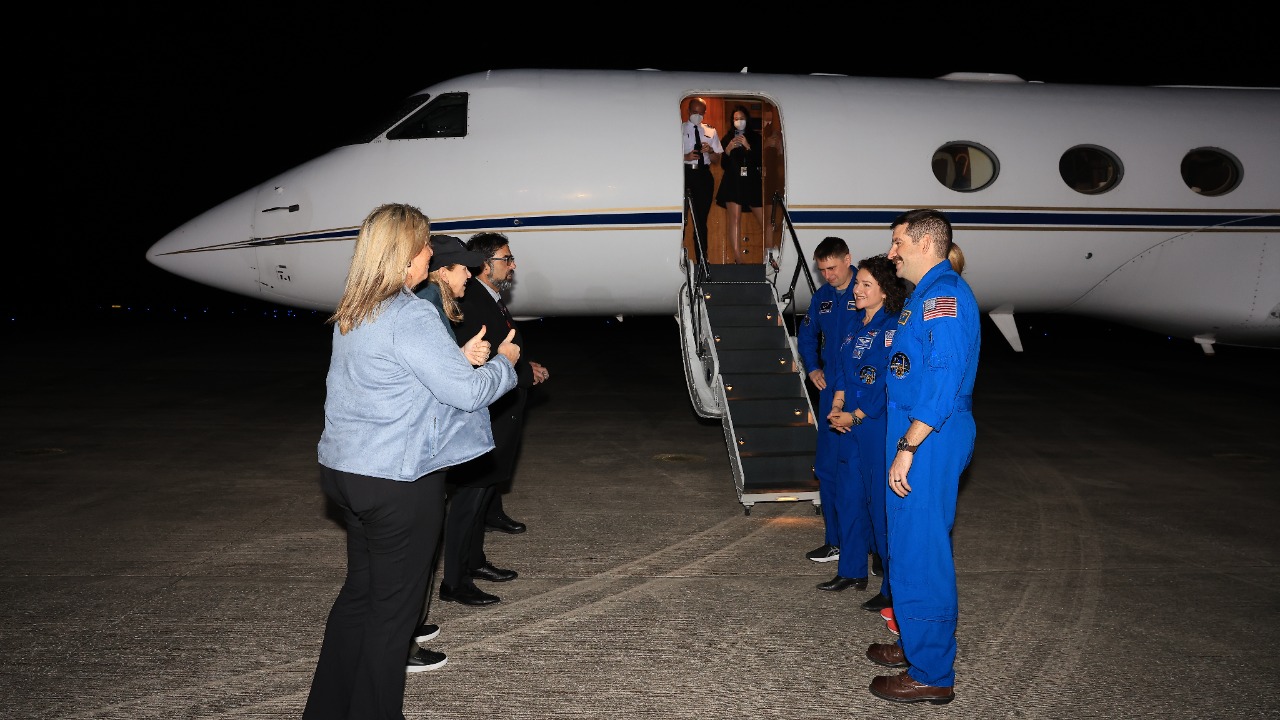
The Crew‑12 manifest brings together four astronauts from three space agencies, a configuration that reflects both geopolitical pragmatism and the station’s original design as a shared laboratory. NASA’s Jack Hathaway and Jessica Martin will serve as the mission’s American representatives, joined by Roscosmos cosmonaut Andrey Fedyaev and a fourth crewmate from another partner agency, forming a team that blends test‑pilot experience, engineering depth, and scientific specialization. Earlier this month, the Four astronauts arrived on Florida’s Space Coast Friday, Feb. 6, giving them time to acclimate to local operations and complete final fit checks before launch, a timeline described in regional coverage of Who the crew are.
NASA has framed this quartet as more than a transport detail, highlighting how their backgrounds align with the mission’s science priorities. In official profiles, the agency notes that Pictured from left in preflight imagery are Roscosmos cosmonaut Andrey Fedyaev and NASA astronauts Jack Hathaway and Jessica Martin, a visual shorthand for the cross‑border cooperation that still defines the International Space Station partnership despite terrestrial tensions. That same briefing, authored by Nathan Cranford, emphasizes how the crew will tackle studies on fluid shifts toward the head and potential changes in circulation, positioning them as both explorers and research subjects in a carefully designed human‑spaceflight experiment, as outlined in the altered gravity overview by Nathan Cranford.
Altered gravity science and the 20% hypothesis
The scientific centerpiece of Crew‑12 is a suite of experiments on adaptation to altered gravity, focusing on how bodily fluids redistribute toward the head in orbit and how that shift affects vision, cardiovascular function, and overall performance. NASA’s brief on the mission explains that microgravity can drive fluid toward the head, potentially altering circulation and contributing to the eye and brain changes that have worried flight surgeons for more than a decade, a concern spelled out in the agency’s altered gravity Roscosmos summary. By pairing in‑flight measurements with pre‑ and post‑flight testing, NASA is effectively turning Crew‑12 into a controlled trial on how targeted exercise, suit design, and fluid management protocols can blunt those effects.
Based on the trajectory of earlier ISS research, it is reasonable to expect that the data from this mission could support a measurable reduction in microgravity‑related health risks, potentially on the order of 20 percent for certain conditions if preflight training and in‑flight countermeasures are tuned correctly. That figure is not yet proven, and any such gain will depend on how closely Crew‑12’s results align with patterns seen in prior expeditions, but the logic is straightforward: better baselines, more frequent monitoring, and individualized countermeasure plans should translate into fewer and less severe symptoms. If that holds, the protocols refined during this eight‑month stay could become standard for future long‑duration crews, from extended lunar Gateway rotations to early Mars transits, much as incremental improvements in airline safety procedures quietly transformed commercial aviation over the span of a few decades.
Launch choreography, dry dress rehearsal, and Falcon 9 readiness
Behind the scenes, the hardware and ground teams have already run through a full‑scale simulation of launch day, known as the dry dress rehearsal, to flush out any procedural or technical snags. NASA reported that earlier today, agency leaders and the Crew‑12 astronauts completed this critical milestone at NASA’s Kenne operations hub, practicing everything from suit‑up to ingress and countdown holds in real time, a level of detail captured in the agency’s rehearsal NASA update. That run‑through, combined with standard static‑fire tests and data reviews, is what allows officials to say with confidence that the ground systems are ready even as they hedge against Florida’s fickle skies.
On the propulsion side, Crew‑12 will ride a flight‑proven Falcon 9 and Crew Dragon configured within the parameters that have now supported multiple crewed missions, a sign that human spaceflight is settling into a more airline‑like cadence. SpaceX’s mission page for Crew-12 outlines the basic profile: a vertical launch from Kennedy, stage separation and booster landing, then a series of orbit‑raising burns before rendezvous. While the company has not advertised major modifications specific to this flight, each mission folds in incremental software updates and hardware inspections that reflect lessons learned from previous crews, a continuous‑improvement loop that mirrors how automakers refine a model year by year without changing the badge on the trunk.
Florida’s launch economy and the stakes of a scrub
Every time a crewed launch slips a day, the impact is felt far beyond the pad, from hotel bookings in Cocoa Beach to the intricate ballet of ISS crew rotations. Local outlets have framed the new target as Thursday, February 12, NASA’s SpaceX Crew‑12 launch from Florida, emphasizing that four crew members from three space agencies will be heading to orbit and that spectators around Florida’s Space Coast are already planning viewing parties, as described in regional launch timing When guides. A further delay would not only disappoint those crowds but also compress the handover window on the station, forcing managers to juggle cargo traffic, spacewalk plans, and the return schedule for the outgoing crew.
More from Morning Overview
*This article was researched with the help of AI, with human editors creating the final content.